Search This Blog

Showing posts with label ielts. Show all posts

Friday, May 31, 2013

TOEFL Reading Diagnostics Test from ETS!


Meteorite Impact and Dinosaur Extinction


There is increasing evidence that the impacts of meteorites have had important effects on Earth, particularly in the field of biological evolution. Such impacts continue to pose a natural hazard to life on Earth. Twice in the twentieth century, large meteorite objects are known to have collided with Earth.

If an impact is large enough, it can disturb the environment of the entire Earth and cause an ecological catastrophe. The best-documented such impact took place 65 million years ago at the end of the Cretaceous period of geological history. This break in Earth’s history is marked by a mass extinction, when as many as half the species on the planet
10 became extinct. While there are a dozen or more mass extinctions in the geological record, the Cretaceous mass extinction has always intrigued paleontologists because it marks the end of the age of the dinosaurs. For tens of millions of years, those great creatures had flourished. Then, suddenly, they disappeared.
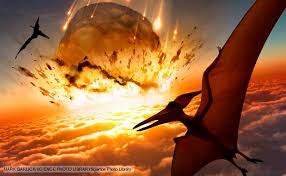

15 The body that impacted Earth at the end of the Cretaceous period was a meteorite with a mass of more than a trillion tons and a diameter of at least 10 kilometers. Scientists first identified this impact in 1980 from the worldwide layer of sediment deposited from the dust cloud that enveloped the planet after the impact. This sediment layer is enriched in the rare metal iridium and other elements that are relatively abundant in a meteorite but
20 very rare in the crust of Earth. Even diluted by the terrestrial material excavated from the crater, this component of meteorites is easily identified. By 1990 geologists had located the impact site itself in the Yucatán region of Mexico. The crater, now deeply buried in sediment, was originally about 200 kilometers in diameter.

25 This impact released an enormous amount of energy, excavating a crater about twice as large as the lunar crater Tycho. The explosion lifted about 100 trillion tons of dust into the atmosphere, as can be determined by measuring the thickness of the sediment layer formed when this dust settled to the surface. Such a quantity of material would have blocked the sunlight completely from reaching the surface, plunging Earth into a period
30 of cold and darkness that lasted at least several months. The explosion is also calculated to have produced vast quantities of nitric acid and melted rock that sprayed out over much of Earth, starting widespread fires that must have consumed most terrestrial forests and grassland. Presumably, those environmental disasters could have been responsible for the mass extinction, including the death of the dinosaurs.
35 Several other mass extinctions in the geological record have been tentatively identified with large impacts, but none is so dramatic as the Cretaceous event. But even without such specific documentation, it is clear that impacts of this size do occur and that their results can be catastrophic. What is a catastrophe for one group of living things, however,
40 may create opportunities for another group. Following each mass extinction, there is a sudden evolutionary burst as new species develop to fill the ecological niches opened by the event.

Impacts by meteorites represent one mechanism that could cause global catastrophes and
45 seriously influence the evolution of life all over the planet. According to some estimates, the majority of all extinctions of species may be due to such impacts. Such a perspective fundamentally changes our view of biological evolution. The standard criterion for the survival of a species is its success in competing with other species and adapting to slowly changing environments. Yet an equally important criterion is the ability of a species to
50 survive random global ecological catastrophes due to impacts.

Earth is a target in a cosmic shooting gallery, subject to random violent events that were unsuspected a few decades ago. In 1991 the United States Congress asked NASA to investigate the hazard posed today by large impacts on Earth. The group conducting the
55 study concluded from a detailed analysis that impacts from meteorites can indeed be hazardous. Although there is always some risk that a large impact could occur, careful study shows that this risk is quite small.


Reading Comprehension questions:

Question 1: The word “pose” on line 2 is closest in meaning to

claim
model
assume
present

Question 2: In paragraph 2, why does the author include the information that dinosaurs had flourished for tens of millions of years and then suddenly disappeared?

To support the claim that the mass extinction at the end of the Cretaceous is the best-documented of the dozen or so mass extinctions in the geological record
To explain why as many as half of the species on Earth at the time are believed to have become extinct at the end of the Cretaceous
To explain why paleontologists have always been intrigued by the mass extinction at the end of the Cretaceous
To provide evidence that an impact can be large enough to disturb the environment of the entire planet and cause an ecological disaster

Question 3: Which of the following can be inferred from paragraph 3 about the location of the meteorite impact in Mexico?

The location of the impact site in Mexico was kept secret by geologists from 1980 to 1990.
It was a well-known fact that the impact had occurred in the Yucatán region.
Geologists knew that there had been an impact before they knew where it had occurred.
The Yucatán region was chosen by geologists as the most probable impact site because of its climate.


Question 4: According to paragraph 3, how did scientists determine that a large meteorite had impacted Earth?

They discovered a large crater in the Yucatán region of Mexico.
They found a unique layer of sediment worldwide.
They were alerted by archaeologists who had been excavating in the Yucatán region.
They located a meteorite with a mass of over a trillion tons.


Question 5: The word “excavating” on line 25 is closest in meaning to

digging out
extending
destroying
covering up


Question 6: The word “consumed” on line 32 is closest in meaning to
changed
exposed
destroyed
covered


Question 7. According to paragraph 4, all of the following statements are true of the impact at the end of the Cretaceous period EXCEPT:

A large amount of dust blocked sunlight from Earth.
Earth became cold and dark for several months.
New elements were formed in Earth’s crust.
Large quantities of nitric acid were produced.


Question 8. The phrase “tentatively identified” on line 36 is closest in meaning to

identified after careful study
identified without certainty
occasionally identified
easily identified

Question 9. The word “perspective” on line 46 is closest in meaning to

sense of values
point of view
calculation
complication

Question 10. Paragraph 6 supports which of the following statements about the factors that are essential for the survival of a species?

The most important factor for the survival of a species is its ability to compete and adapt to gradual changes in its environment.
The ability of a species to compete and adapt to a gradually changing environment is not the only ability that is essential for survival.
Since most extinctions of species are due to major meteorite impacts, the ability to survive such impacts is the most important factor for the survival of a species.
The factors that are most important for the survival of a species vary significantly from one species to another.


Question 11. Which of the sentences below best expresses the essential information in the following sentence?

Earth is a target in a cosmic shooting gallery, subject to random violent events that were unsuspected a few decades ago.

Incorrect choices change the meaning in important ways or leave out essential information.
Until recently, nobody realized that Earth is exposed to unpredictable violent impacts from space.
In the last few decades, the risk of a random violent impact from space has increased.
Since most violent events on Earth occur randomly, nobody can predict when or where they will happen.
A few decades ago, Earth became the target of random violent events originating in outer space.

Question 12. According to the passage, who conducted investigations about the current dangers posed by large meteorite impacts on Earth?

Paleontologists
Geologists
The United States Congress
NASA

Question 13. Look at the four letters (A, B, C, and D) that indicate where the following sentence could be added to the passage in paragraph 6.

This is the criterion emphasized by Darwin’s theory of evolution by natural selection.

Where would the sentence best fit?
Impacts by meteorites represent one mechanism that could cause global catastrophes and seriously influence the evolution of life all over the planet. (A) According to some estimates, the majority of all extinctions of species may be due to such impacts. (B) Such a perspective fundamentally changes our view of biological evolution. (C) The standard criterion for the survival of a species is its success in competing with other species and adapting to slowly changing environments. (D) Yet an equally important criterion is the ability of
a species to survive random global ecological catastrophes due to impacts.


Choose the place where the sentence fits best.
Option A
Option B
Option C
Option D


Question 14:
An introductory sentence for a summary of the passage is found below. Complete the summary by choosing the THREE answer choices that contain the most imporant ideas in the passage. Some sentences do not fit in the summary because they provide ideas that are not mentioned in the passage or are only minor ideas from the passage. This question is worth 2 points.


Scientists have linked the mass extinction at the end of the Cretaceous with a meteorite impact on Earth.

(1) Scientists had believed for centuries that meteorite activity influenced evolution on Earth.
(2) The site of the large meteorite impact at the end of the Cretaceous period was identified in 1990.
(3) There have also been large meteorite impacts on the surface of the Moon, leaving craters like Tycho.
(4) An iridium-enriched sediment layer and a large impact crater in the Yucatán provide evidence that a large meteorite struck Earth about
65 million years ago.
(5) Large meteorite impacts, such as one at the end of the Cretaceous period, can seriously affect climate, ecological niches, plants, and
animals.
(6) Meteorite impacts can be advantageous for some species, which thrive, and disastrous for other species, which become extinct.

Most important ideas -  Choice no 1 , 2 , 4
Most important ideas -  Choice no 3 , 4 , 6
Most important ideas -  Choice no 4 , 5 , 6
Most important ideas -  Choice no 1 , 5 , 6

Thursday, May 30, 2013

What should be my CGPA to avail funding for higher studies in Canada?


I am a member of a group called Prospective Bangladeshi Students for Canadian universities. Few days ago they have, published a list of around 20+ students who got funding. I have gone through their profile and extract some valuable information. Hope this will give you a better idea about getting funding in Canada.

CGPA :
This will break a lot of peoples heart but there are few exceptions too.
The average CGPA was 3.75 and the median was 3.79. 
So if your CGPA is above 3.70 you are way ahead of the race.


Do you want to know the number of publication you should have to avail funding?
See this post!


Tuesday, May 28, 2013

TOEFL IELTS Score Requirement for Canadian Universities - Ontario


"All of these data are collected from the university's website as on 28th May 2013. This requirement may varies according to program. These data can be used as MINIMUM REQUIREMENT."


University of Waterloo


Undergrad studies

 Choose ONE of the following test options
Internet-based TOEFL(iBT)IELTS MELAB CAELNew TestPTE(Academic) EFAS
90; writing 25; speaking 25 7.085; 80 per section; for co-op programs: speaking 370; 60 per band; writing 70; speaking 7063; writing 65; speaking 6580% overall in level 400
(Revised - effective fall 2013 entry: 75% overall in 400 level with 75% in each of academic, oral, and writing)


Graduate studies

Accepted ELPC examinationsRequired scores
TOEFL (PBT)
Paper based test
580 overall
TOEFL (iBT)
Internet based test
90 overall; 25 writing; 25 speaking
IELTS (academic)7.0 overall
MELAB85 overall; 80 per section
CAEL
70 overall; 60 per band; 70 writing; 70 speaking
PTE (academic)63 overall; 65 writing; 65 speaking
EFAS80% overall in level 400
WHANT TO KNOW HOW MUCH YOU SHOULD SCORE? 

University of Toronto

Undergrad & Graduate 


TOEFL
Test of English as a Foreign Language
The minimum scores required for the different TOEFL tests are:


Internet-based Test:

Minimum Requirement
total score of 100 + 22 on Writing

Discretionary Range
total score 89-99 +19 - 21 on Writing

Paper-based Test:

Minimum Requirement
total score of 600 + 5.0 on TWE

Discretionary Range
total score 573-597 + 4.5 on TWE

If you score in the discretionary ranges shown above, and you are otherwise well qualified for admission, we will automatically consider other academic evidence of English proficiency (for example, results of English courses) and we will advise you whether our English language requirements have been satisfied. It is not necessary to request this special consideration. Letters of reference will NOT be used for this purpose. As we cannot guarantee that these scores will be accepted, we recommend that you take another test if the final official results can be submitted to us by the appropriate document deadline. 


IELTS
International English Language Testing System (IELTS) Academic Module
The minimum requirement is an overall band of 6.5, with no band below 6.0.


BROCK University

Undergrad studies


TOEFL IBT (Internet-based Test of English as a Foreign Language), MELAB (Michigan English Language Assessment Battery), IELTS (International Language Testing System), PTE Academic (Pearson Test of English), or ITELP (International Test of English Language Proficiency) scores. Normally, only those with TOEFL IBT scores of 88 or greater, with a minimum of 21 on Speaking and 21 on Writing; MELAB scores of 85 or greater, with no other part under 80; IELTS scores of 6.5 or greater, with no band below 6.0; PTE Academic scores of 58; or ITELP scores of 565 or greater with a minimum composition score of 240 will be considered for admission.

Graduate studies

A minimum TOEFL PBT (Paper Based Test) score of 550 plus 4.0 minimum for the TWE (Test of Written English), or TOEFL iBT (Internet based) minimum overall score of 80 with no sub-test score under 19;

or
A minimum score of 6.5 on the International English Language Testing System - Academic (IELTS), with no section under 5.5;


Undergrad & Graduate studies

Paper-based TOEFL             580
Internet-based TOEFL      86 (22 in writing and speaking, 20 in reading and listening)
IELTS                                     6.5 IELTS (min 6.0 each band)


Undergrad studies
The International English Language Testing System (IELTS) with a minimum overall score of 6.5 with no band less than 6.
The Test of English as a Foreign Language (TOEFL) :
Paper-based: minimum score of 600; and Test of Written English (TWE) of 5
Computer-based: minimum score of 250; and TWE of 5
Internet-based: minimum total score of 89 with no individual scaled score less than 21

Graduate
International English Language Testing System (IELTS)
6.5
Test of English as a Foreign Language (TOEFL - Paper based test (PBT)
550
Test of English as a Foreign Language (TOEFL Internet-based test (IBT))
Note: A minimum score of 21 must be achieved in each of the four categories (listening, speaking, reading, writing).

89

Undergrad and Grad

A minimum score of 6.5 on the International English Language Testing System (IELTS);
A minimum score of 220 with a T.W.E. 4.5 on the Computer-based Test, 83 with an essay score of 20 on the Internet-based Test of English as a Foreign Language (T.O.E.F.L.)


Undergrad
Minimum English Proficiency Results 
(subject to change - use as a guideline only)
Program
TOEFL - 0886
MELAB
IELTS
CAEL
- Creative Industries
- Journalism 
-Professional Communication
- Radio and Television
-580 Paper-based
-92-93 Internet-based
90
6.5
70
All Faculty of Engineering and Architectural Science programs except Architectural Science
All Faculty of Science programs except Computer Science
-560 Paper-based
-83-87 Internet-based
85
6.5
60
All other Ryerson programs 
-580 Paper-based
-92-93 Internet-based
85
6.5
70
  
Graduate
Please note, meeting the minimum English proficiency requirements does not guarantee admission. Programs may set additional requirements to these minimum standards.
Academic ProgramTOEFL (IBT)IELTSMELAB
General Requirement937.085
Computer Networks806.580
Communication and Culture1007.590
Journalism1057.590
Psychology1007.590
*Other English proficiency scores may be considered on an individual basis


Undergrad & Grad


TOEFL(Test of English as a Foreign Language) www.toefl.com IBT: 
86 
overall with a minimum score of 20 on each of the four components (Reading, Writing, Speaking, Listening)
Valid for 2 years

IELTS(International English Language Testing System)
6.5 Overall with a minimum score of 5.0 in each of the  four components (Reading, Writing, Speaking, Listening)


TOEFL
Paper based: 580 written : 4.5
iBT: 92 Writen : 24

IELTS 
Total : 7 
Written :6.5


Monday, May 27, 2013

TOEFL IELTS Reading exercise 07

This exercise is helpful for both TOEFL and IELTS test takers.

Government subsidies to farmers
(Level - Hard)


All these activities may have damaging environmental impacts.  For example, land clearing for agriculture is the largest single cause of deforestation; chemical fertilisers and pesticides may contaminate water supplies; more intensive farming and the abandonment of fallow periods tend to exacerbate soil erosion; and the spread of monoculture and use of high-yielding varieties of crops have been accompanied by the disappearance of old varieties of food plants which might have provided some insurance against pests or diseases in future.  Soil erosion threatens the productivity of land in both rich and poor countries.  The United States, where the most careful measurements have been done, discovered in 1982 that about one-fifth of its farmland was losing topsoil at a rate likely to diminish the soil's productivity.  The country subsequently embarked upon a program to convert 11 per cent of its cropped land to meadow or forest.  Topsoil in India and China is vanishing much faster than in America. 

Government policies have frequently compounded the environmental damage that farming can cause.  In the rich countries, subsidies for growing crops and price supports for farm output drive up the price of land.  The annual value of these subsidies is immense: about $250 billion, or more than all World Bank lending in the 1980s.  To increase the output of crops per acre, a farmer's easiest option is to use more of the most readily available inputs: fertilisers and pesticides.  Fertiliser use doubled in Denmark in the period 1960-1985 and increased in The Netherlands by 150 per cent.  The quantity of pesticides applied has risen too: by 69 per cent in 1975-1984 in Denmark, for example, with a rise of 115 per cent in the frequency of application in the three years from 1981. 

In the late 1980s and early 1990s some efforts were made to reduce farm subsidies.  The most dramatic example was that of New Zealand, which scrapped most farm support in 1984.  A study of the environmental effects, conducted in 1993, found that the end of fertiliser subsidies had been followed by a fall in fertiliser use (a fall compounded by the decline in world commodity prices, which cut farm incomes).  The removal of subsidies also stopped land-clearing and over-stocking, which in the past had been the principal causes of erosion.  Farms began to diversify.  The one kind of subsidy whose removal appeared to have been bad for the environment was the subsidy to manage soil erosion. 

In less enlightened countries, and in the European Union, the trend has been to reduce rather than eliminate subsidies, and to introduce new payments to encourage farmers to treat their land in environmentally friendlier ways, or to leave it fallow.  It may sound strange but such payments need to be higher than the existing incentives for farmers to grow food crops.  Farmers, however, dislike being paid to do nothing.  In several countries they have become interested in the possibility of using fuel produced from crop residues either as a replacement for petrol (as ethanol) or as fuel for power stations (as biomass).  Such fuels produce far less carbon dioxide than coal or oil, and absorb carbon dioxide as they grow.  They are therefore less likely to contribute to the greenhouse effect.  But they are rarely competitive with fossil fuels unless subsidised - and growing them does no less environmental harm than other crops. 


01 Research completed in 1982 found that in the United States soil erosion - 
A  reduced the productivity of farmland by 20 per cent. 
B  was almost as severe as in India and China. 
C  was causing significant damage to 20 per cent of farmland. 
D  could be reduced by converting cultivated land to meadow or forest. 

02 By the mid-1980s, farmers in Denmark - 
 A  used 50 per cent less fertiliser than Dutch farmers. 
B  used twice as much fertiliser as they had in 1960. 
C  applied fertiliser much more frequently than in 1960. 
D  more than doubled the amount of pesticide they used in just 3 years. 

03 Which one of the following increased in New Zealand after 1984? 
A  farm incomes 
B  use of fertiliser 
C  over-stocking 
D  farm diversification 


1. C 
2. B 
3. D

Sunday, May 26, 2013

TOEFL IELTS Reading Exercise (Topic: Short Term Memory)


Short Term Memory

1    Most people can remember a phone number for up to thirty seconds. When this short amount of time elapses, however, the numbers are erased from the memory. How did the information get there in the first place? Information that makes its way to the short term memory (STM) does so via the sensory storage area. The brain has a filter which only allows stimuli that is of immediate interest to pass on to the STM, also known as the working memory.

2    There is much debate about the capacity and duration of the short term memory. The most accepted theory comes from George A. Miller, a cognitive psychologist who suggested that humans can remember approximately seven chunks of information. A chunk is defined as a meaningful unit of information, such as a word or name rather than just a letter or number. Modern theorists suggest that one can increase the capacity of the short term memory by clunking or classifying similar information together. By organizing information, one can optimize the STM, and improve the chances of a memory being passed on to long term storage.

3   When making a conscious effort to memorize something, such as information for an exam, many people engage in "rote rehearsal". By repeating something over and over again, one is able to keep a memory alive. Unfortunately, this type of memory maintenance only succeeds if there are no interruptions. As soon as a person stops rehearsing the information, it has the tendency to disappear. When a pen and paper are not handy, people often attempt to remember a phone number by repeating it aloud. If the doorbell rings or the dog barks to come in before a person has the opportunity to make a phone call, he will likely forget the number instantly.* Therefore, rote rehearsal is not an efficient way to pass information from the short term to long term memory.* A better way is to practice "elaborate rehearsal". *This involves assigning semantic meaning to a piece of information so that it can be filed along with other preexisting long term memories.*


4     Encoding information semantically also makes it more retrievable. Retrieving information can be done by recognition or recall. Humans can easily recall memories that are stored in the long term memory and used often; however, if a memory seems to be forgotten, it may eventually be retrieved by prompting. The more cues a person is given (such as pictures), the more likely a memory can be retrieved. This is why multiple choice tests are often used for subjects that require a lot of memorization.

Glossary:
semantic: relating to the meaning of something


Reading Comprehension questions:

Question 1: According to the passage, how do memories get transferred to the STM?

They revert from the long term memory.
They are filtered from the sensory storage area.
They get chunked when they enter the brain.
They enter via the nervous system.

Question 2: The word elapses in paragraph 1 is closest in meaning to:

passes
adds up
appears
continues

Question 3: All of the following are mentioned as places in which memories are stored EXCEPT the:

STM
long term memory
sensory storage area
maintenance area


Question 4: Why does the author mention a dog's bark?

To give an example of a type of memory
To provide a type of interruption
To prove that dogs have better memories than humans
To compare another sound that is loud like a doorbell


Question 5: Look at the four stars (*) that indicate where this sentence can be added to the passage. Where would the sentence fit best?


For example, a reader engages in elaborate rehearsal when he brings prior knowledge of a subject to a text.

After 1st Star (*)
After 2nd Star (*)
After 3rd Star (*)
After 4th Star (*)


Question 6: How do theorists believe a person can remember more information in a short time?

By organizing it
By repeating it
By giving it a name
By drawing it


Question 7: The author believes that rote rotation is:

the best way to remember something
more efficient than chunking
ineffective in the long run
an unnecessary interruption


Question 8: The word it in the last paragraph refers to:

encoding
STM
semantics
information


Question 9: The word elaborate in paragraph 3 is closest in meaning to:

complex
efficient
pretty
regular


Question 10: Which of the following is NOT supported by the passage?

The working memory is the same as the short term memory.
A memory is kept alive through constant repetition.
Cues help people to recognize information.
Multiple choice exams are the most difficult.


Question 11: The word cues in the passage is closest in meaning to

questions
clues
images
tests

Question 12: Which of the following best provides the important informaton in the highlighted sentence from the passage. Incorrect answer choices leave out essential information or change the meaning of it

Prompting is the easiest way to retrieve short term memory after an extended period of time.
A memory can be retrieved by prompting, in a case where it has been rarely used.
It's easier to remember short term memories than long term memories due to regular prompts.
Recalling a long term memory that is often used is easy, while forgotten memories often require prompting.


Question 13:
An introductory sentence for a summary of the passage is found below. Complete the summary by choosing the THREE answer choices that contain the most imporant ideas in the passage. Some sentences do not fit in the summary because they provide ideas that are not mentioned in the passage or are only minor ideas from the passage. This question is worth 2 points.

The brain stores information that a person may need in the immediate future in a place called the short term memory (STM).

1. Most people can only remember numbers for a short time.
2. Many psychologists agree that only a certain amount of information can be stored in the STM at once.
3. Some techniques for memorization don't work because of potential interruptions.
4. Elaborate rehearsal is generally considered less effective than rote rehearsal.
5. Assigning meaning to information makes it easier for the brain to retrieve.

Most important ideas -  Choice no 1 , 2 , 3
Most important ideas -  Choice no 1 , 2 , 4
Most important ideas -  Choice no 2 , 3 , 5
Most important ideas -  Choice no 1 , 3 , 5

More Exercises Search!